
Harthof's Integrated, Innovative Shared Mobility Concept
This project is developing a transferable shared mobility concept for the Harthof district of Munich that integrates public and private services using data-driven methods and stakeholder participation.
General information
- Client
- Landeshauptstadt München
- Period
- 2024-2025
Planning cases
Overview
The “Integrated and Innovative Sharing Mobility Concept” project is part of the EU-funded initiative ASCEND - Accelerate Positive Clean Energy Districts, which aims to develop a “Positive Clean Energy District” in the Harthof district of Munich by 2027. Alongside innovative approaches in energy supply, building retrofitting, and smart city technologies, the development of sustainable mobility solutions is a core component. The goal is to create an integrated mobility concept that considers both public and private mobility offerings and promotes alternatives to private car use. Using data-driven methods, stakeholder engagement, and advanced planning tools like GOAT, the project addresses key mobility challenges.****
Project Consortium:
The project is jointly implemented by the following partners:
• stattbau münchen GmbH: Experts in socially networked and sustainable urban development with extensive experience in developing innovative housing and mobility concepts.
• Plan4Better GmbH: Developers of the GOAT platform, specializing in data-driven mobility and urban planning as well as geodata analysis.
• Good Mobility Council: Specialists in integrating shared mobility into urban structures, particularly in the context of certifications and user-centric approaches.
Focus Areas:
Within the consortium, specific work packages are being implemented, focusing on:
• Granular data collection: Collecting and analyzing data on accessibility and walkability using existing municipal data sources, such as the digital twin, sociodemographic data, and land use information, to ensure inclusion and mobility for all user groups.
• Accessibility analysis: Examining the accessibility of shared mobility services and daily needs destinations to enable optimal location decisions.
• Shared mobility usage analysis: Evaluating rental data and analyzing the use of public spaces by shared mobility providers to derive data-based recommendations.
• Data-Driven Parking Demand: Calculation of high-resolution residential parking demand based on local accessibility, sociodemographics, and land use.
• Scenario modeling and recommendations: Developing models and specific proposals to integrate mobility services into the urban structure.
• Stakeholder engagement: Using analysis results in workshops and dialogue formats with stakeholders and citizens to develop practical and widely accepted solutions.
Goals and Outcomes:
• Development of a comprehensive shared mobility concept for the Harthof district that can be scaled to other neighborhoods in Munich and beyond.
• Integration of private mobility services by property managers such as Münchner Wohnen, complemented by public offerings increasingly bundled at mobility hubs.
• Provision of collected and analyzed data for integration into the digital twin to support the long-term use and further development of the concept.
• Strengthening collaboration between private and public actors while engaging the local community to create mobility solutions that simplify residents’ daily lives and address their specific needs.
Highlights:
The project demonstrates how data-driven and participatory approaches can enhance the integration of mobility concepts in existing neighborhoods. Through close collaboration among the partners, a comprehensive concept is being developed that addresses mobility challenges with innovative solutions.
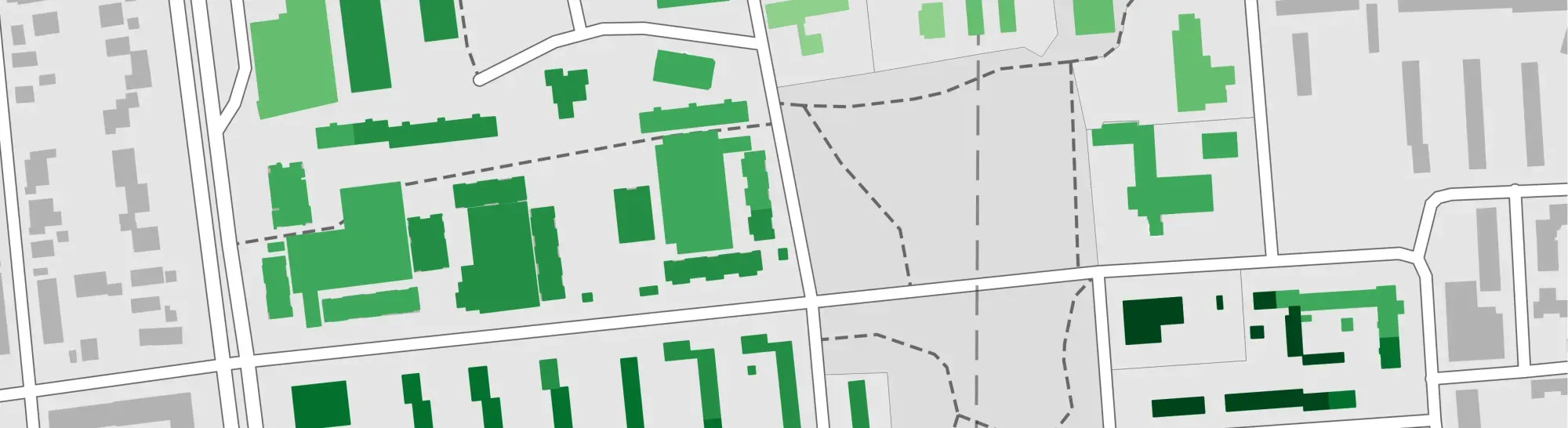
Harthof Bevölkerung
Erschließung Mobilitätspunkte Harthof Untersuchungsgebiet Harthof Bevölkerung
If you liked this, take a look at

EX-TRA - Experimenting with city streets to transform urban mobility
Use of GOAT in Ghent, Amsterdam, London, Bologna and Munich to conduct accessibility analyses and identify suitable locations for street experiments.
Read the referenceSiting mobility stations, or scoring a 15-minute city?
Book a slot and we will run the question you actually have on your own area.
Ready to make sense of your data?
Join planners, organizations and cities using GOAT to make better decisions, faster. No GIS expertise needed.